Fortune of Olympus — How Does Cluster Pays Change the Gates of Olympus Formula?
For four years, the Gates of Olympus franchise followed a single blueprint: a 6x5 grid, scatter pays with 8+ matching symbols anywhere, tumble cascades, and Zeus dropping multiplier orbs. Every sequel from the 2021 original through Gates of Olympus 1000 (2023), Gates of Olympus Dice (2024), Xmas 1000 (2024), and Super Scatter (2025) kept that formula intact. The changes were typically cosmetic, such as higher multiplier caps, festive skins, and bigger max wins. The mechanical DNA never changed.
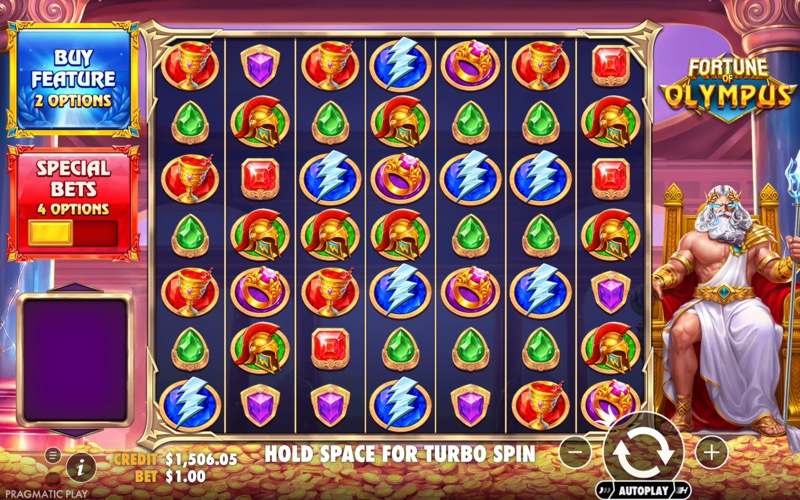
Fortune of Olympus broke the formula. Released on December 18, 2025, it became the first Gates of Olympus game to abandon scatter pays entirely. The grid expands from 6x5 (30 positions) to 7x7 (49 positions). Wins now form through Cluster Pays, where 5 or more identical symbols connected horizontally or vertically create a payout. Position matters for the first time. Where your symbols land and how they connect determines whether you win, because adjacency replaces random distribution as the core win condition.
This is not a cosmetic refresh. Cluster pays and scatter pays produce different mathematical distributions, different visual experiences, and different emotional rhythms during play. The tumble cascade, multiplier orbs (2x to 500x), and accumulating Global Multiplier during Free Spins carry over from franchise DNA. However, the way those features interact with the 7x7 grid creates a session that feels genuinely new.
Pragmatic Play COO Irina Kornides described Fortune of Olympus as “a stunning addition offering an outstanding experience with epic win potential.” Beyond the marketing language, the data supports her claim: Fortune of Olympus features the highest base RTP in the franchise (96.55%), the most complex staking system (6 tiers), and a volatility rating of High (4/5) rather than the Very High (5/5) that typically defines Gates of Olympus 1000 and Super Scatter. By measurable metrics, it is the most moderate and mechanically distinctive entry in the lineup.
This review examines every layer of Fortune of Olympus in detail: how cluster pays work, the full paytable, RTP configurations, Free Spins and Super Free Spins, all six staking tiers with bankroll math for each, a structured franchise comparison, common myths, and who this game is actually designed for.
What Are the Key Numbers for Fortune of Olympus?
| Metric | Value |
|---|---|
| Developer | Pragmatic Play |
| RTP | 96.55% (94.54-96.55) |
| Volatility | High |
| Max Win | 10,000x |
| Grid | 7x7 |
| Paylines | Cluster Pays |
| Min Bet | $0.20 |
| Max Bet | $240.00 |
| Game Type | Cluster Pay |
| Year | 2025 |
The 3.45% house edge means Fortune of Olympus keeps $3.45 of every $100 wagered across millions of spins. This is a mathematical certainty built into the certified paytable — no strategy, timing, or bet pattern changes it.
How Does Fortune of Olympus Work?
Fortune of Olympus uses a 7x7 grid with 49 symbol positions, a 63% increase over the 30-position 6x5 grid used in every other Gates of Olympus title. Wins require 5 or more identical symbols connected adjacently, touching horizontally or vertically. Diagonal connections do not count. The shape of the cluster does not matter: an L-shape, a straight line, a T-shape, or a meandering blob all qualify.
How Cluster Pays Form
Imagine 7 purple gems landing on the grid. If all 7 are connected, each touching at least one other purple gem by sharing a horizontal or vertical edge, they form a single cluster of 7 and pay according to the 7 to 9 cluster tier on the paytable. However, if 5 are connected and 2 are isolated, only the group of 5 pays. Adjacency is the defining rule. You must be able to trace a path from any symbol in the cluster to any other without lifting your finger or moving diagonally.
The Tumble Feature
After every winning cluster, the symbols in that cluster are removed from the grid. All symbols above the gaps fall downward. New symbols fill in from the top. This is identical to the tumble cascade mechanic in the scatter-pays variants. However, on a 7x7 grid, tumble chains generally tend to be longer on average because there are more positions for new clusters to form as symbols shift. The extra 19 positions create chain reactions that the smaller 6x5 grid simply cannot produce.
Cluster Pays vs Scatter Pays: Structural Comparison
| Attribute | Scatter Pays (Gates of Olympus Original / 1000 / Super Scatter) | Cluster Pays (Fortune of Olympus) |
|---|---|---|
| Grid Size | 6x5 (30 positions) | 7x7 (49 positions) |
| Win Requirement | 8+ matching symbols anywhere on grid | 5+ matching symbols connected adjacently |
| Position Matters? | No, only total count | Yes, symbols must touch |
| Diagonal Connections | N/A | Do not count |
| Cluster Shape | N/A (no clusters) | Any shape (L, T, line, square, blob) |
| Minimum for Pay | 8 symbols | 5 symbols |
| Maximum Theoretical Cluster | 30 (entire grid) | 49 (entire grid) |
| Tumble Mechanic | Yes | Yes |
| Multiplier Orbs | Yes (2x-500x or 2x-1,000x) | Yes (2x-500x) |
| Global Multiplier (Free Spins) | Yes | Yes |
| Visual Tracking | Scan entire grid for matching symbols | Track connected groups with spatial awareness |
| Tumble Chain Potential | Moderate (30 positions) | Higher (49 positions, more repositioning) |
In scatter-pays Gates of Olympus, you scan the entire grid and count matching symbols, because their location is irrelevant. In Fortune of Olympus, you track spatial patterns: where symbols land relative to each other, how tumbles might connect isolated groups, whether a single cascade could bridge two near-miss clusters into one large payout. The game rewards spatial awareness rather than simple counting.
The lower win threshold (5 symbols vs 8) compensates for the adjacency requirement. Although five connected symbols on a 49-position grid sounds easy, random placement rarely produces large connected groups without tumble assistance. The tumble mechanic is the primary mechanism that builds clusters from near-misses into hits, making cascade chains the emotional and mathematical core of Fortune of Olympus.
What Does Each Symbol Pay?
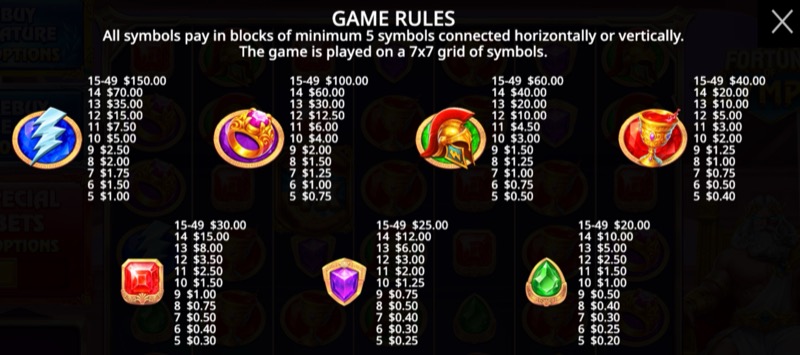
Fortune of Olympus pays based on cluster size, the number of connected identical symbols. The 7x7 grid (49 positions) theoretically allows clusters from 5 to 49 symbols, although clusters beyond 20 are exceptionally rare. Payouts are expressed as multiples of total bet and scale across tiers from 5 to 15+ connected symbols.
Symbol Hierarchy
The paytable features 7 regular symbols arranged in a clear hierarchy. Four premium symbols — Lightning Bolt (highest), Ring, Helmet, and Goblet — sit above three low-pay gem symbols (Red, Purple, and Green). The Lightning Bolt awards 150x total bet for a cluster of 15 or more connected symbols. Small clusters of 5 to 6 symbols pay modestly; even the Lightning Bolt pays around 1x for a minimum cluster.
Paytable Analysis
The paytable follows the Gates of Olympus franchise structure with a steep scaling curve between cluster-size tiers. The gap between the top premium symbol and the lowest gem is significant, creating a wide payout distribution within the base game before multiplier orbs are applied.
Cluster-size scaling is steep. Growing a cluster from the minimum 5-6 tier to the maximum 15+ tier can increase your payout by orders of magnitude. Tumble chains that extend an existing cluster are disproportionately valuable — adding 3 to 4 symbols to a medium cluster can double or triple the payout tier.
Important context: These paytable values are base payouts before multiplier orb application. During Free Spins, the accumulated Global Multiplier applies to all cluster wins, which is where the game’s theoretical 10,000x maximum win becomes achievable. A 150x Lightning Bolt cluster hit during a Free Spins round with a 66.7x accumulated Global Multiplier would yield 10,000x, the cap. Such outcomes are rare, but the math confirms they are structurally possible.
RTP, Probabilities & Mathematical Edge
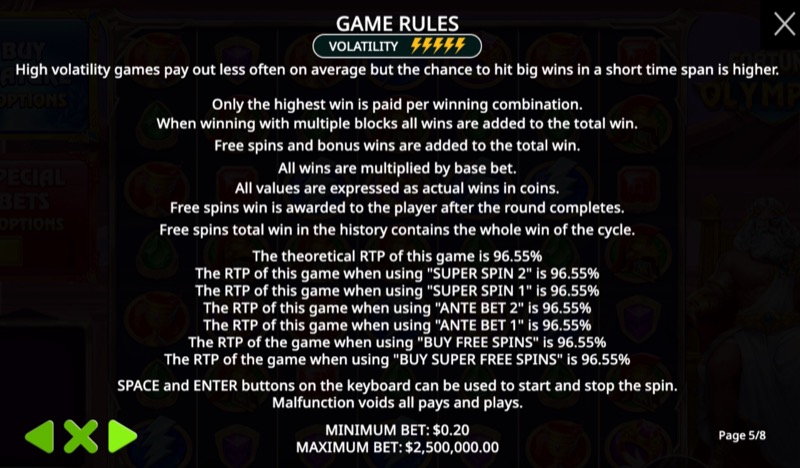
Fortune of Olympus has a default RTP of 96.55%, the highest base RTP in the Gates of Olympus franchise. Every other title typically operates at 96.50% default.
RTP Configurations
| Configuration | RTP | House Edge | Expected Loss per $1,000 |
|---|---|---|---|
| Maximum (Default) | 96.55% | 3.45% | $34.50 |
| Medium | 95.55% | 4.45% | $44.50 |
| Minimum | 94.54% | 5.46% | $54.60 |
Unlike every other Gates of Olympus slot (which generally uses 96.50/95.50/94.50), Fortune of Olympus has unique RTP tiers. The 0.05% advantage translates to $0.50 saved per $1,000 wagered compared to any other franchise title at default settings. Since late 2024, Pragmatic Play has required operators to display the active RTP configuration, so you should always verify before playing. For RTP verification methods, see the Best Casinos guide.
Volatility context: Fortune of Olympus is rated High volatility (4/5) by Pragmatic Play, one tier below the Very High (5/5) rating of Gates of Olympus 1000, Super Scatter, and Xmas 1000. Your variance band is narrower: fewer extremely long dry spells, fewer jackpot-level wins. The win distribution is compressed toward the centre compared to its Very High siblings, because the 500x orb cap limits peak swings.
The RTP applies equally across all six staking tiers. Ante Bet, Super Spin, and Buy Feature options do not change the underlying RTP.
How Do Free Spins Trigger and Pay?
Free Spins in Fortune of Olympus use the accumulating Global Multiplier from the Gates of Olympus franchise, but with key structural differences due to the 7x7 grid. The larger grid generally creates more tumble opportunities per spin, which often results in faster multiplier accumulation.
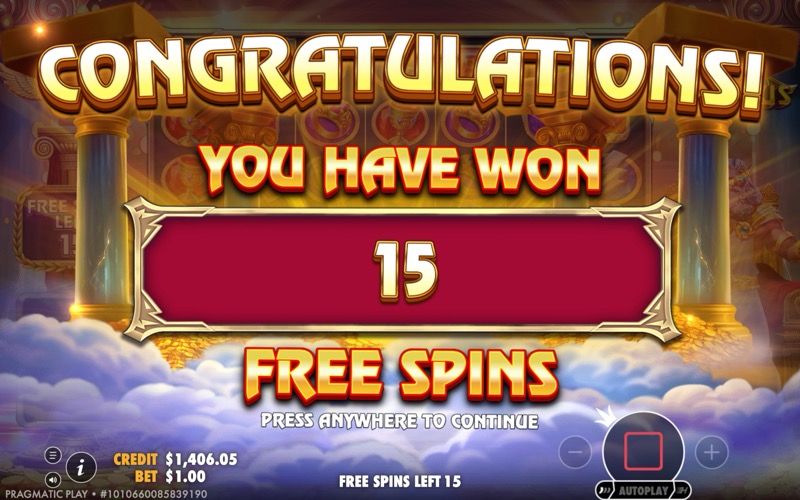
Trigger: 4 to 7 Scatters (Expanded Range)
| Scatters | Free Spins | Context |
|---|---|---|
| 4 Scatters | 15 Free Spins | Most common trigger |
| 5 Scatters | 20 Free Spins | Possible on 7x7 grid |
| 6 Scatters | 25 Free Spins | Rare |
| 7 Scatters | 30 Free Spins | Does not exist on 6x5 games |
The expanded scatter range is a direct consequence of the larger grid. With 49 positions instead of 30, the probability of landing 5, 6, or even 7 scatters increases. The 7-scatter trigger remains extremely rare but awards 30 Free Spins, double the standard trigger. This possibility did not exist in any previous Gates of Olympus title, because the 6x5 grid capped practical scatter landings at 6.
Retrigger: Requires 4+ Scatters
Unlike the original (3+ scatters for +5 spins), Fortune of Olympus requires 4+ scatters for retrigger and awards 15 to 30 additional spins depending on scatter count. This is more restrictive but more rewarding per retrigger. A single 4-scatter retrigger adds 15 spins, three times the original’s +5 bonus. The trade-off favours longer individual bonus rounds over frequent small extensions.
Super Free Spins (500x Buy)
The Super Free Spins variant starts your Global Multiplier at 5x instead of 1x. A 15+ Lightning Bolt cluster (150x base) on spin 1 yields 750x immediately, vs 150x in standard Free Spins. This makes early wins significantly more valuable, because the multiplier floor eliminates cold starts entirely. The 5x floor is exclusive to Fortune of Olympus within the franchise — no other title offers a guaranteed starting multiplier at this level.
Max win cap: 10,000x (between the original’s 5,000x and 1000’s 15,000x). The Global Multiplier typically builds to 15x to 50x over 15 spins, although higher values are possible with dense orb landings.
How Do the Multiplier Orbs Work?
Multiplier orbs use the same 15 values (2x to 500x) and same additive behaviour as the original Gates of Olympus. However, the 7x7 grid changes how orbs interact with your gameplay in important ways.
How the 7x7 Grid Changes Orb Impact
On the 7x7 cluster pays grid, orbs land among 49 positions instead of 30. The 500x cap means fewer extreme single-orb jumps compared to the 1000 series, so the Global Multiplier generally builds more gradually and consistently. A typical Free Spins round might see your multiplier climb from 1x to 25x over 10 spins, whereas Gates of Olympus 1000 can spike from 1x to 1,000x on a single orb landing. The emotional experience is therefore quite different: Fortune of Olympus sessions tend to build tension gradually rather than delivering sudden explosive moments.
During base game spins, orb values reset after each paid spin — they only accumulate during Free Spins. Because the 7x7 grid produces longer tumble chains on average, each spin generates more opportunities for orbs to appear within a single cascade sequence. This means base game orb exposure is generally higher than on the 6x5 grid, even though the individual orb values are identical.
| Metric | Fortune of Olympus | GoO 1000 Series |
|---|---|---|
| Max Orb | 500x | 1,000x |
| Max Win | 10,000x | 15,000x |
| Volatility | High (4/5) | Very High (5/5) |
| Build Pattern | Gradual, consistent | Spiky, orb-dependent |
The lower volatility rating (4/5 vs 5/5) is partly attributed to the 500x orb cap. Although both games use the same additive mechanic, the 1000 series can produce dramatic single-orb Global Multiplier jumps that Fortune of Olympus cannot match. Your session will likely feel steadier, with fewer extreme highs and fewer devastating collapses.
Are the Buy Feature and Ante Bet Worth It?
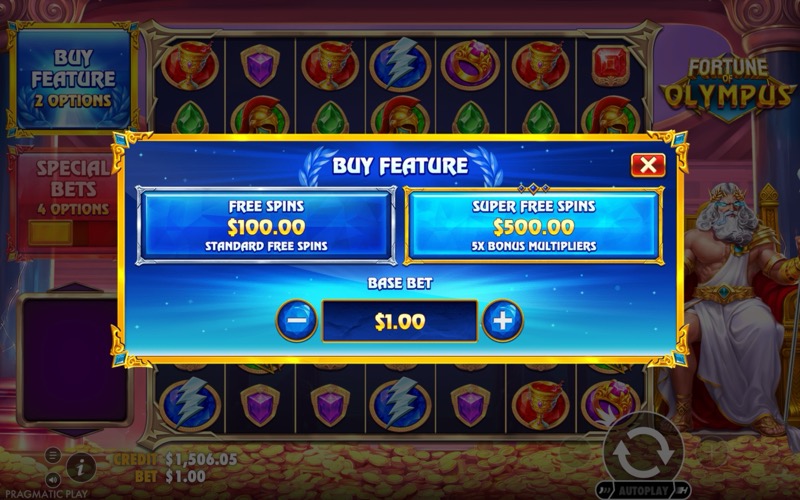
Fortune of Olympus features the most complex staking system in the Gates of Olympus franchise. Six distinct tiers are available in supported jurisdictions, each fundamentally changing your cost structure, trigger frequency, and session risk profile.
Complete Staking Tier Breakdown
| Tier | Cost Multiplier | Cost at $0.20 Base | What It Does | RTP |
|---|---|---|---|---|
| Base Game | 1x (standard) | $0.20/spin | Standard play, no enhancements | ~96.55% |
| Ante Bet 1 | 40x per spin | $8.00/spin | 5x chance of Free Spins | ~96.55% |
| Ante Bet 2 | 140x per spin | $28.00/spin | 5x chance of Free Spins + guaranteed minimum 5x Global Multiplier in bonus | ~96.55% |
| Super Spin 1 | 200x per spin | $40.00/spin | Guarantees at least 1 multiplier orb lands every spin | ~96.55% |
| Super Spin 2 | 5,000x per spin | $1,000.00/spin | Guarantees a multiplier orb of 50x or higher every spin | ~96.55% |
| Buy Free Spins | 100x (one-time) | $20.00/bonus | Instantly triggers Free Spins (standard, 1x starting multiplier) | ~96.55% |
| Buy Super Free Spins | 500x (one-time) | $100.00/bonus | Instantly triggers Free Spins with 5x starting Global Multiplier | ~96.55% |
Tier-by-Tier Analysis
Base Game (1x): Standard play with no modifications. Triggers occur at natural frequency and multiplier orbs land at natural rates. This is the lowest-variance way to play and the only option without amplified cost. Generally recommended for extended session time.
Ante Bet 1 (40x per spin): Costs 40x the base bet per spin ($8.00 instead of $0.20). Your Free Spins trigger chance is multiplied by 5x. However, the 40x spend applies to every spin, not just triggers. The 5x trigger chance partially compensates through more frequent bonus entries, although net expected RTP remains ~96.55%.
Ante Bet 2 (140x per spin): Costs 140x per spin ($28.00). Provides the same 5x trigger chance as Ante Bet 1, plus a guaranteed minimum 5x Global Multiplier when Free Spins activate. The possibility of a “cold” bonus with a 1x to 3x ending multiplier is eliminated entirely.
Super Spin 1 (200x): Costs 200x per spin ($40.00) and guarantees at least one multiplier orb on every spin. This transforms the base game’s sporadic orb appearance into a consistent stream. The 200x per-spin cost burns bankroll extremely fast — 10 spins costs $400 at $0.20 base.
Super Spin 2 (5,000x): The most extreme staking option in the entire franchise. At 5,000x per spin ($1,000.00 at $0.20 base), every spin guarantees a multiplier orb of 50x or higher. Designed for ultra-high-stakes players seeking maximum multiplier density.
Buy Free Spins (100x): Pay 100x your bet ($20.00) to instantly trigger Free Spins with a standard 1x starting Global Multiplier. Most bonus rounds return less than entry cost; some return multiples of it.
Buy Super Free Spins (500x): Pay 500x ($100.00) to trigger Free Spins with a 5x starting Global Multiplier. The 5x head start turns every early-round win into a meaningful payout and accelerates the compounding effect of additional orbs.
Jurisdiction Availability
Not all six tiers are available in every market. Ante Bet and Buy Feature options are restricted or prohibited in certain jurisdictions, such as the UK (where buy features are banned), Sweden, and others with enhanced responsible gambling regulations. Check your casino’s interface for which options are displayed.
What Does the Math Mean for Your Bankroll?
Fortune of Olympus at its default 96.55% RTP has a 3.45% house edge. However, the tiered staking system creates radically different bankroll scenarios that demand separate analysis for each tier.
Cost and Bankroll Scenario Table
| Mode | Cost per Spin ($0.20 base) | 100 Spins Cost | Expected Loss (100 spins) | Recommended Minimum Bankroll | Max Win at $0.20 |
|---|---|---|---|---|---|
| Base Game | $0.20/spin | $20.00 | $0.69 | $100+ | $2,000 |
| Ante Bet 1 | $8.00/spin | $800.00 | $27.60 | $100+ | $2,000 |
| Ante Bet 2 | $28.00/spin | $2,800.00 | $96.60 | $125+ | $2,000 |
| Super Spin 1 | $40.00/spin | $4,000.00 | $138.00 | $3,000+ | $2,000 |
| Super Spin 2 | $1,000.00/spin | $100,000.00 | $3,450.00 | $50,000+ | $2,000 |
| Buy Free Spins | $20.00/bonus | n/a | n/a | $300+ | $2,000 |
| Buy Super Free Spins | $100.00/bonus | n/a | n/a | $1,500+ | $2,000 |
Super Spin 2: Extreme Bankroll Requirements
At $1,000 per spin ($0.20 base), this mode is designed for an extremely narrow player segment:
- 10 spins: $10,000 wagered. Expected loss: $345. Actual results vary wildly at High volatility.
- 50 spins: $50,000 wagered. Expected loss: $1,725. Your actual outcome will likely differ substantially from the expected value.
- Break-even requirement: You need average returns of 5,000x or higher per spin to break even. The 10,000x cap means you need several max-cap or near-cap wins to offset the cumulative cost.
The guaranteed 50x+ orb per spin is valuable but does not guarantee net-positive outcomes. Multiplier orbs only have value when applied to winning clusters. A 500x orb on a spin with no winning cluster contributes nothing to your balance. The RTP remains ~96.55% regardless of tier — higher tiers offer different variance profiles, not mathematical advantages.
Hourly Cost Comparison
Assuming approximately 200 spins per hour (manual play):
| Mode | Hourly Cost (200 spins/hr, $0.20 base) | Expected Hourly Loss |
|---|---|---|
| Base Game | $40 | $1.38 |
| Super Spin 1 | $8,000 | $276.00 |
| Super Spin 2 | $200,000 | $6,900.00 |
Variable RTP impact: All figures above assume 96.55% RTP. At the minimum 94.54% configuration, the house edge rises to 5.46%, increasing all expected losses by approximately 58%. Always verify your casino’s active RTP configuration before playing at any tier.
How Does Fortune of Olympus Compare to Other Games?
Fortune of Olympus is the only franchise title with fundamentally different mechanics. For the full franchise comparison across all 8 titles, see the franchise overview. The differences are not incremental — they are structural.
What Makes Fortune of Olympus Unique
- Only cluster pays in the franchise: 7x7 grid with 5+ adjacent symbols required (vs 6x5 scatter pays on all other titles). Position matters for the first time.
- Highest base RTP: 96.55% (vs 96.50% on all others), marginal but unique in the lineup.
- Lowest volatility: High (4/5) vs Very High (5/5), generally producing more consistent mid-range returns and fewer extreme swings.
- Most staking flexibility: 6 tiers vs 3 options on all other titles, including Super Spin tiers that did not exist before.
- Super Free Spins: 5x starting multiplier, exclusive to Fortune of Olympus.
- Mid-range ceiling: 10,000x sits between the original (5,000x) and GoO 1000 (15,000x).
For players seeking a genuinely different play experience within the Zeus/Olympus theme, Fortune of Olympus is the only option. Every other title shares the same 6x5 scatter-pays foundation. However, “different” does not automatically mean “better.” Your preference depends on whether you value spatial gameplay over scatter-based counting, and whether you want the 4/5 volatility profile or the 5/5 extremes that other titles provide.
Fortune of Olympus in the Gates of Olympus Franchise
Fortune of Olympus is part of the 8-game Gates of Olympus franchise and represents the biggest mechanical departure — the first to break from the 6x5 scatter-pays formula with a 7x7 cluster pays grid. For the full timeline and variant comparison, see the franchise overview.
Common Myths and Scams Debunked
For common slot myths such as predictor apps, timing strategies, and gambler’s fallacy, see the main guide. Below are myths specific to Fortune of Olympus’s cluster-pays mechanics.
“Bigger Grid = Bigger Wins”
Misleading. The 7x7 grid has 49 positions vs 30 on 6x5, but cluster pays requires adjacency, which is more restrictive than scatter pays’ “anywhere on grid” approach. The max win (10,000x) falls between the original (5,000x) and GoO 1000 (15,000x). More positions create more tumble opportunities, but the ceiling is set by the paytable and multiplier cap, not grid size alone. A bigger grid does not automatically produce bigger wins.
“Cluster Pays Are Better Than Scatter Pays”
Neither is objectively better. Cluster pays (5-symbol minimum) typically produces more frequent small-to-medium wins from chains. Scatter pays (8-symbol minimum) generally produces fewer but larger triggers. The house edge is nearly identical (3.45% vs 3.50%). Although cluster pays might feel more engaging because of the spatial element, the math does not favour either system. Choose based on your session preference, not perceived mathematical superiority.
“Super Spin 2 Guarantees Profit”
False. Super Spin 2 costs 5,000x per spin and guarantees a 50x+ orb every spin. However, orbs only have value when applied to winning clusters. A 500x orb on a spin with zero wins contributes nothing. The RTP across all six staking tiers remains ~96.55%. You are paying for higher multiplier density, not a mathematical advantage. The house edge does not change regardless of tier.
“The 7x7 Grid Makes Retriggers Easier”
Partially true but misleading. The larger grid does allow up to 7 scatters (vs 6 maximum on the 6x5 grid), expanding the possible scatter range. However, Fortune of Olympus requires 4+ scatters for retrigger instead of the original’s 3+. The higher threshold partially offsets the larger grid’s scatter capacity. Retriggers are more rewarding when they hit (15-30 spins vs +5), but they occur less frequently than in the original.
Who Is Fortune of Olympus Actually For?
Ideal Player Profiles
The Gates of Olympus Veteran Seeking Novelty: If you have played hundreds of sessions on Gates of Olympus Original or Gates of Olympus 1000 and the scatter-pays formula feels stale, Fortune of Olympus delivers genuinely different gameplay within a familiar brand. The cluster mechanic changes how you experience every spin — you track spatial patterns instead of counting scattered symbols.
The Moderate Volatility Seeker: At High volatility (4/5), Fortune of Olympus is the least extreme entry in a franchise dominated by Very High (5/5) titles. If Gates of Olympus 1000 or Super Scatter typically drain your bankroll too aggressively, Fortune of Olympus offers a wider distribution of mid-range wins with fewer devastating dry spells.
The Cluster Pay Enthusiast: If you enjoy cluster-pay mechanics from games such as Sugar Rush or other grid-based cluster slots, Fortune of Olympus applies that mechanic to the Gates of Olympus franchise’s multiplier-orb system. It is the intersection of cluster formation and accumulating global multipliers.
The Staking Strategist: Fortune of Olympus’s six-tier staking system is the most sophisticated in the franchise. You can modulate between gentle base-game play and extreme Super Spin 2 sessions, adjusting to your bankroll and risk appetite on a spin-by-spin basis.
Consider Alternatives If…
You want maximum win ceiling: Gates of Olympus Super Scatter offers 50,000x, five times Fortune of Olympus’s 10,000x cap. Gates of Olympus 1000 offers 15,000x.
You want the classic experience: Gates of Olympus Original remains the definitive 6x5 scatter-pays experience.
You prefer extreme volatility: Gates of Olympus 1000 and Super Scatter are both rated Very High (5/5).
You want simplicity: Fortune of Olympus’s 6-tier staking system can feel overwhelming. Any other Gates of Olympus variant offers three straightforward options.
You want a fundamentally different game type: Gates of Olympus Roulette takes the franchise into live casino with 97.30% RTP and real dealer interaction.
Our Verdict on Fortune of Olympus
Fortune of Olympus is the most important Gates of Olympus release since the 2021 original, not because of its numbers, but because of its mechanics. It is the first franchise title that genuinely plays differently. The 7x7 cluster-pays grid replaces the 6x5 scatter-pays formula that defined seven preceding titles, creating a game that rewards spatial awareness and produces different emotional rhythms during play.
Pros
- Highest RTP in the franchise: 96.55% vs 96.50% across all other titles
- Most moderate volatility: High (4/5) vs Very High (5/5), typically producing a less punishing session experience
- Most complex staking system: 6 tiers offering unprecedented control over your risk profile
- Genuinely different mechanics: cluster pays on a larger grid is a structural change to how wins form
- Longer tumble chains: the 49-position grid generally creates more cascade opportunities
Cons
- 10,000x max win: below Gates of Olympus 1000 (15,000x) and far below Super Scatter (50,000x)
- 500x orb cap: matches the Original but half the 1000 series, reducing peak bonus-round volatility
- Complexity: the 6-tier staking system requires understanding, especially the extreme Super Spin tiers
- Adjacency requirement: sometimes frustrating when near-miss clusters fail to connect by a single position
Fortune of Olympus does not replace any existing Gates of Olympus title. It adds a mechanically distinct option to the franchise. If you want the highest ceiling, play Super Scatter. If you want the proven classic, play the Original. If you want maximum multiplier orbs, play Gates of Olympus 1000. If you want something that genuinely plays differently — cluster pays on a 7x7 grid with the most sophisticated staking system in the franchise — Fortune of Olympus is the only option. Your decision should be based on which mechanic appeals to you, not which game is “best” in the abstract.
Rating: 4.5/5: Deducted for the relatively modest max win ceiling and the potential for the complex staking system to encourage irresponsible play at higher tiers. The mechanical innovation and franchise-best RTP earn the highest score given to a Gates of Olympus title outside the Original.
Responsible Gambling
The house always wins long-term. Set a loss limit before every session and never chase losses. Fortune of Olympus’s six-tier staking system can encourage rapid bankroll depletion, especially at Super Spin 1 and Super Spin 2 levels. Super Spin 2 at $0.20 base costs $1,000 per spin — 10 spins depletes $10,000 in wagers. Start at the base game tier and only move to enhanced tiers if your bankroll can absorb extended losing streaks without financial stress. Full guide: Responsible Gambling | Help: BeGambleAware · Gambling Therapy
Expert Analysis
For detailed analysis, see the franchise overview, cluster pays mechanics, and staking tier breakdown.
Other Gates of Olympus Variants
Explore more guides from the Gates of Olympus franchise:
- Gates of Olympus — 96.50% RTP, High volatility, 5,000x max win
- Gates of Olympus 1000 — 96.50% RTP, Very High volatility, 15,000x max win
- Gates of Olympus Super Scatter — 96.50% RTP, High (5/5) volatility, 50,000x max win
- Gates of Olympus Dice — 96.50% RTP, Very High volatility, 5,000x max win
- Gates of Olympus Xmas 1000 — 96.50% RTP, Very High volatility, 15,000x max win
- Gates of Olympus 1000 Dice — 96.50% RTP, Very High volatility, 15,000x max win
- Gates of Olympus Roulette — 97.30% RTP, Medium volatility, 10,000x max win